| HS Code | 798686 |
| Density | 0.90 g/cm³ |
| Melt Flow Rate | 1.5 g/10min |
| Tensile Strength At Yield | 25 MPa |
| Elongation At Break | 250% |
| Flexural Modulus | 1100 MPa |
| Izod Impact Strength 23c | 9 kJ/m² |
| Izod Impact Strength 20c | 3 kJ/m² |
| Heat Deflection Temperature 0 45mpa | 85 °C |
| Vicat Softening Temperature | 150 °C |
| Rockwell Hardness | R85 |
| Melting Point | 165 °C |
| Mold Shrinkage | 1.2% |
As an accredited Polypropylene EPS30R factory, we enforce strict quality protocols—every batch undergoes rigorous testing to ensure consistent efficacy and safety standards.
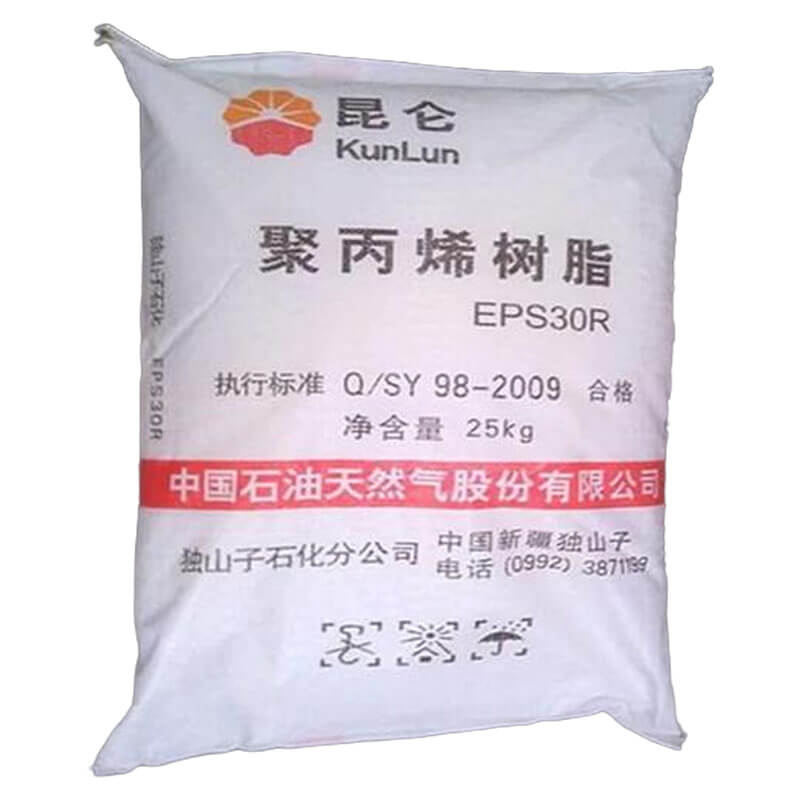
| Packing | Polypropylene EPS30R is supplied in 25 kg woven polypropylene bags with inner PE liner, palletized and shrink-wrapped. |
| Container Loading (20′ FCL) | Polypropylene EPS30R packed in 20′ FCL, palletized bags, securely stowed, protected from moisture and heat. |
| Shipping | Polypropylene EPS30R is an impact copolymer thermoplastic resin supplied as solid pellets. It is non-hazardous for transport and not regulated as dangerous goods under IMDG, ADR, or IATA. Ship in clean, dry containers or sealed bags, protected from moisture, heat, and direct sunlight. Avoid dust accumulation during handling. |
| Storage | Store Polypropylene EPS30R in a cool, dry, well-ventilated area, away from direct sunlight, heat sources, and open flames. Keep original containers tightly sealed to prevent moisture contamination and dust accumulation. Avoid exposure to extreme temperatures. Under proper conditions, material remains stable with a long shelf life. No special storage restrictions required. |
| Shelf Life | Polypropylene EPS30R has an indefinite shelf life when stored in a cool, dry place away from direct sunlight and heat. |
In the moulding of thick-walled lead-acid battery containers, EPS30R is fed at 96.0–98.0 wt% with a carbon black masterbatch at 2.0–4.0 wt% and, in multi-cavity production, a 0.5–1.5 wt% processing-aid masterbatch to reduce mould deposit on two-platen machines rated at 6,000–12,000 kN clamp force. The melt mass-flow rate band of 1.2–2.0 g/10 min under ISO 1133-1:2022 is deliberately retained because higher-flow grades reduce injection pressure but shift weld-line elongation and acid-stress-cracking resistance unfavourably. Melt temperature is held at 210–230 °C and mould temperature at 30–50 °C while filling wall sections of 4.0–6.0 mm with flow lengths above 300 mm; below 210 °C, the frozen-layer-to-flow-channel ratio increases and cavity packing near the bottom grid becomes incomplete. After de-moulding, lid welding by hot-plate uses a plate temperature of 240–260 °C and weld bead penetration of 0.5–1.2 mm; weld burst pressure is then measured on a hydraulic burst tester at 0.2 MPa/s ramp rate according to the battery assembler’s internal specification. Sulfuric acid resistance is evaluated by immersion in 37% H₂SO₄ at 60 °C for 28 days following ASTM D543-21 Procedure B, with property retention measured by ISO 178:2019 flexural modulus and ISO 179-1:2020 Charpy impact. Flammability classification is UL 94 HB at 3.0 mm; converters supplying automotive aftermarket batteries also verify dimensional stability at 85 °C for 24 h against a 0.5 mm warp tolerance. Finished types include automotive starting battery cases, deep-cycle traction battery containers, and VRLA battery lids with integrated flame-arrestor housings. A production-scale failure mode is sink mark formation over internal rib intersections when pack pressure decays before gate freeze; the countermeasure is a hold-pressure profile of 45–60 MPa for 8–12 s per 1 mm of wall thickness, verified by short-shot-to-seal studies on the cavity-pressure curve.
Talc-filled compounds based on EPS30R for automotive interior trim are formulated at 70–80 wt% resin, 15–25 wt% compacted talc with median particle size below 8 µm, 5–10 wt% ethylene-octene elastomer, and 0.3–0.8 wt% stabiliser package comprising hindered phenolic antioxidant, phosphite, and a hindered amine light stabiliser. Compounding is performed on a twin-screw extruder with L/D 40:1, side feeding of talc after the melt seal, and melt temperature capped at 220 °C to limit volatile degradation products. Injection moulding uses a sequential valve-gated hot runner with three to five drops on a 13,000–20,000 kN clamp-force machine; melt temperature is held at 200–230 °C, mould temperature at 25–45 °C, and screw rotation below 80 min⁻¹ to avoid screw recovery delays when back pressure is set at 3–6 MPa. Back pressure above 6 MPa raises melt temperature and increases total VOC emissions, measured by VDA 277 against an upper limit of 50 µg/g; fogging condensate is measured according to DIN 75201 Method B with a 2.0 mg maximum. Dimensional stability after conditioning at 23 ± 2 °C and 50 ± 5% relative humidity for 48 h is checked with ISO 527-2:2012 tensile modulus and ISO 178:2019 flexural modulus; OEM specifications typically require a coefficient of linear thermal expansion below 4.0 × 10⁻⁵ K⁻¹ for pillar trim clip retention. Grain replication is quantified by structured surface depth retention of ≥ 85% against an electroformed cavity texture; low melt temperature improves grain, but injection speed must remain above 60 mm/s to prevent hesitation marks at rib bases. Finished components include instrument panel lower covers, centre console side panels, pillar trim, door panel carriers, and fuse box covers. When parts are painted, washability is verified by ISO 2409:2020 cross-cut adhesion after a waterborne primer; unpainted parts require scratch resistance measured by ISO 1518-1:2019 with a 0.75 mm stylus at 10 N load, meeting no visible whitening under D65/10° illuminant. Recyclate is excluded from visible grain surfaces because batch-to-batch contamination shifts melt rheology and increases silver-streak frequency; published data for exact OEM show-through limits under direct sunlight is limited.
A cold-chain crate formulation may combine EPS30R at 75–90 wt% with recycled propylene impact copolymer at 10–25 wt% and a UV masterbatch at 2–4 wt%; the recycled fraction is pre-sorted by melt mass-flow rate and ash content to keep batch-to-batch viscosity variation below ±10%. The moulding cell uses a high-accumulator injection unit delivering shot weights of 3–8 kg into single- or dual-cavity tools on machines with 18,000–25,000 kN clamp force; melt temperature is 215–235 °C, mould temperature 20–40 °C, and holding pressure 35–50 MPa for 12–25 s to pack rib intersections without overstressing the gate. Cold-chain applications are validated with ISO 8611-1:2021 for pallet bending under rated loads and ASTM D4169-22 for simulated distribution cycles at −20 °C; a notched Charpy impact acceptance threshold of 5–7 kJ/m² at −20 °C is used for the EPS30R/recyclate blend per ISO 179-1:2020. Low-velocity impact at 23 °C is tested by ISO 6603-2:2021 with a 4.4 m/s striker, on flat regions at least 150 mm from weld lines. Weathering for outdoor storage uses ISO 4892-2:2013 Method A cycle 1 for 1,000 h; colour shift is assessed with ISO 11664-4:2008 against a ΔE*ab limit of 3.0. Processing conflict arises because the recycled fraction increases melt viscosity and shear heating at screw recovery; this is managed with a barrier screw of L/D 22:1, back pressure 4–8 MPa, and screw cooling where barrel zone 5 exceeds 240 °C. Heat-staked identification plates use 200–240 °C probe temperature and 0.3–0.6 MPa applied pressure for 4–8 s. Finished types include collapsible dairy crates, meat trays with drainage, bakery trays, pallet boxes, and agricultural harvest crates. EPS30R is not suitable for continuous steam sterilisation above 121 °C; repeated autoclave cycles cause warpage beyond 2 mm on 1,200 mm side lengths and reduce hinge flexural life.
Office chair seat shells require flexural fatigue resistance under alternating loads, and EPS30R is processed in machines with clamp force of 12,000–16,000 kN using a melt temperature of 210–235 °C and a mould temperature of 25–45 °C; the material is charged neat at 97.0–99.0 wt% with colour masterbatch at 1.0–3.0 wt%, and in seats with integral lumbar flex zones a 5–10 wt% metallocene plastomer is added to raise elongation at break above 400% per ISO 527-2:2012. The tool includes multiple fan gates around the perimeter to orient flow parallel to the rear flexure axis; weld lines are unacceptable within 50 mm of armrest boss holes. Structural testing follows ANSI/BIFMA X5.1-2020 seat fatigue cycles of 100,000 at 75 kg proof load and EN 1728:2012 downward static load for armrests at 900 N; EPS30R parts show acceptable creep only when nominal wall thickness is 3.0–4.5 mm, and rib-to-wall ratios above 0.7 produce sink marks on visible surfaces. Gas-assisted injection moulding is used for armrests with thick boss attachments: nitrogen pressure is profiled from 6–12 MPa over 10–20 s after short shot, reducing cycle time by 15–25% compared with solid moulding, but gas channel diameter must remain below 8 mm to avoid surface blistering. Pre-drying is not required when resin is stored in sealed original packaging below 60% relative humidity; if exposed above 60% RH for more than 8 h, hopper drying at 80 °C for 2–3 h prevents splay. Finished components include office chair shells, auditorium seat backs, table corner brackets, and load-bearing armrests. Batch-to-batch variance in melt mass-flow rate beyond ±0.3 g/10 min shifts gate freeze time and changes boss pull-out resistance; processors compensate by adjusting hold pressure in 2–4 MPa increments. Published data for gas-assisted EPS30R under cyclic flexing in mesh-backed chairs is limited; validation is performed on pilot tools before multi-cavity commitments.
Refrigerator door caps and washing machine balance ring housings present thin-to-thick wall transitions of 2.0 mm to 8.0 mm within one shot, and compounds based on EPS30R are formulated at 85–95 wt% resin with 5–15 wt% talc or barium sulfate masterbatch for increased flexural modulus without sacrificing hinge break resistance. The material is moulded on a two-platen machine with clamp force of 10,000–18,000 kN, melt temperature 205–225 °C, mould temperature 25–40 °C, and a two-stage injection velocity profile: 25–40 mm/s through the hinge section to prevent jetting and 50–80 mm/s through the main wall to maximise pressure transmission. Screw back pressure is kept below 5 MPa to limit frictional heating, because talc-filled versions degrade above 240 °C and deposit acidic volatiles on the barrel. Electrical safety is verified under IEC 60335-1:2020 with glow-wire testing at 650 °C for unattended appliance components; flammability is classified as UL 94 HB at 3.0 mm. Hinge durability is tested on a pneumatic hinge cycler at 10,000–50,000 open-close cycles at 23 °C and −10 °C; the acceptance criterion is no crack longer than 2.0 mm at the gate or boss on either temperature condition. Finished types include refrigerator door end caps, freezer drawer fronts, washing machine balance ring housings, dryer lint trap frames, and dishwasher kickplate brackets. Uneven cooling at the thick wall of the balance ring causes sink marks; the countermeasure is a hold-pressure profile of 40–55 MPa for 10–15 s and a mould temperature gradient of 5–10 °C across the cavity. For freezer drawers, low-temperature Izod impact is measured by ISO 180:2019 at −20 °C with a minimum value of 8 kJ/m² in the hinge gate area; published data for EPS30R after 1,000 h of refrigerator door cap thermal cycling from −10 °C to 40 °C is limited.
Barrel temperature profiling for EPS30R garden power tool housings is set to a rear zone of 190–210 °C, centre zones of 210–225 °C, and nozzle of 215–230 °C; this is paired with a general-purpose screw of 20:1 L/D, a compression ratio of 2.4:1, and a shot-to-barrel ratio of 30–60% to avoid hydrolytic splay when regrind is used. The formulation uses 80–90 wt% EPS30R, 5–15 wt% in-house regrind from sprues and reject housings, 2–5 wt% UV masterbatch for outdoor weathering, and 0.5–1.0 wt% nucleating agent to reduce spherulite size and improve part gloss uniformity. Moulding is on 8,000–14,000 kN machines with melt cushion controlled at 3–5 mm; screw recovery time is monitored as a key process parameter because the 1.2–2.0 g/10 min melt mass-flow rate can push recovery beyond cooling time at elevated screw speeds, causing melt temperature spikes above 250 °C and brittleness at weld lines. Weathering is tested by ISO 4892-2:2013 Method A cycle 1 for 800–1,200 h; surface chalking is quantified by ISO 4628-6:2016 to a rating of ≤ 2, and impact retention after exposure is measured by ISO 179-1:2020 Charpy notched impact at 23 °C. Dimensional checks follow ISO 291:2008 conditioning class 23/50 for 24 h; internal bosses and snap-fit arms are checked for creep after 48 h at 80 °C and 80% relative humidity, with a maximum deflection of 0.5 mm under 150 N preload. Finished products include electric lawn mower motor covers, string trimmer spool housings, leaf blower volutes, hedge trimmer gear casings, and ride-on mower fender panels. EPS30R without a flame-retardant package does not pass UL 94 V-2 at 1.5 mm; applications requiring glow-wire or flame-retardant grades use an alternative base resin, as published data for EPS30R in flame-retardant power tool housings is limited.
Competitive Polypropylene EPS30R prices that fit your budget—flexible terms and customized quotes for every order.
For samples, pricing, or more information, please contact us at +8618136850665 or mail to sales4@ascent-chem.com.
We will respond to you as soon as possible.
Tel: +8618136850665
Email: sales4@ascent-chem.com
Flexible payment, competitive price, premium service - Inquire now!
Polypropylene EPS30R is a heterophasic impact copolymer grade supplied for injection molding of technical parts that require a combination of rigidity, creep resistance, and low-temperature impact strength. The grade is classified as a medium-flow polypropylene with a nominal melt flow rate of 1.5 g/10 min under ISO 1133-1:2022 at 230°C and 2.16 kg. This flow position excludes it from high-speed thin-wall packaging, but makes it suitable for thick-wall automotive components, crates, pallets, household appliance housings, industrial containers, battery cases, and other structural injection moldings. The material is not intended for transparent applications because the dispersed ethylene-propylene rubber phase scatters light.
| Property | Test method | Typical value |
|---|---|---|
| Melt flow rate at 230°C/2.16 kg | ISO 1133-1:2022 | 1.5 g/10 min |
| Density | ISO 1183-1:2019 | 0.90 g/cm³ |
| Tensile yield stress | ISO 527-2:2012 | 25 MPa |
| Tensile elongation at break | ISO 527-2:2012 | >200% |
| Flexural modulus | ISO 178:2019 | 1,000 MPa |
| Notched Izod impact at 23°C | ISO 180 | 45 kJ/m² |
| Notched Izod impact at -20°C | ISO 180 | 8 kJ/m² |
| Vicat softening temperature | ISO 306:2022/A50 | 150°C |
| Heat deflection temperature at 0.45 MPa | ISO 75-2:2013/B | 85°C |
The impact performance of EPS30R originates from a heterophasic morphology: a continuous isotactic polypropylene matrix carries a dispersed ethylene-propylene rubber phase. The continuous phase provides modulus and tensile strength, while the rubber domains absorb impact energy and prevent crack propagation at temperatures below the matrix glass transition. The ethylene content and rubber particle size distribution are controlled through polymerization and are proprietary; lot-specific values are reported on certificate of analysis. The grade has a broad molecular weight distribution that produces shear-thinning behavior in injection molding. Under typical cavity shear rates of 10² s⁻¹ to 10³ s⁻¹, apparent viscosity is substantially lower than the zero-shear viscosity. At low shear rates below 10 s⁻¹, higher viscosity assists packing and reduces drool. Dynamic parallel-plate rheometry at 230°C over a frequency sweep of 0.1 rad/s to 100 rad/s is recommended for lot qualification. The melt flow rate is a single-point quality control index and should not be interpreted as a Newtonian viscosity.
During plastication, the screw must generate sufficient dispersive mixing to distribute the rubber phase without overworking the polymer. A compression ratio of 2.5:1 to 3.5:1 and a clean check ring seating are required for shot-to-shot consistency. If the non-return valve leaks more than 5% of shot volume, cushion variation can lead to inconsistent packing and localized sink marks. Production-scale failures traced to poor melt homogeneity often present as anisotropic impact behavior, where notched Izod values in gate regions differ from end-of-flow regions by more than 15%. Published data on this grade’s lot-to-lot rheology variance is limited, but processor qualification should include dynamic rheological testing rather than reliance on melt flow rate alone.
On reciprocating-screw injection molding machines with 45 mm to 80 mm screw diameters and 20:1 to 24:1 L/D ratios, EPS30R requires a controlled thermal profile between 210°C and 250°C at the nozzle. Melt temperatures below 210°C increase viscosity, making filling of long flow paths difficult and raising injection pressure. Melt temperatures above 270°C accelerate thermal-oxidative degradation, producing discoloration and reducing low-temperature impact retention. Mold temperature should normally be maintained between 30°C and 60°C. At mold temperatures below 30°C, surface replication and impact performance in thin hinge or snap-fit areas can deteriorate; above 60°C, cycle time increases without proportional property gain. Back pressure between 0.5 MPa and 1.0 MPa assists in homogenizing the dispersed rubber phase. Screw surface speed should be limited to less than 1.0 m/s to avoid shear heating that can produce localized degradation. Decompression of 3 mm to 6 mm prevents nozzle drool, but excessive decompression can introduce air and silver streaks.
Drying is not routinely required for unopened packaging because polypropylene is non-hydrolytic. However, if regrind or improperly stored material is used, surface condensation at relative humidity above 60% can cause splay and inconsistent melt delivery. Pre-drying for 2 h at 80°C with a desiccant dryer having a dew point below -30°C is adequate for such conditions. The regrind fraction should be kept below 20 wt% unless process validation demonstrates equivalent impact retention; higher regrind fractions reduce notched Izod impact at -20°C due to molecular weight reduction and rubber-phase degradation. In hot-runner systems, runner temperature should be kept below 250°C and residence time below 10 min to avoid thermal degradation. In cold-runner molds, cold slug wells should be sized to trap the colder front of the melt stream.
After ejection, mold shrinkage of unreinforced EPS30R is typically 1.5% to 2.0% in the flow direction and 1.0% to 1.5% transverse to flow, depending on packing pressure and gate geometry. Packing pressure should be held until gate freeze, with gate freeze time for a 2.5 mm wall at 40°C mold temperature on the order of 6 s to 10 s; published data for specific tooling configurations is limited. Holding pressure is typically 60% to 80% of peak injection pressure. Inadequate packing produces sink marks at ribs and bosses, while excessive packing increases molded-in stress and can induce warpage in large flat parts. Parts with wall thickness transitions greater than 3:1 should be redesigned or gated into heavier sections to minimize differential shrinkage and void formation.
The primary difference from homopolymer polypropylene is the presence of the ethylene-propylene rubber phase, which raises notched Izod impact at 23°C from about 3 kJ/m² for a general-purpose homopolymer to approximately 45 kJ/m² for EPS30R, while reducing flexural modulus from about 1,500 MPa to approximately 1,000 MPa. This trade-off has consequences for rib design: load-bearing ribs in EPS30R need slightly thicker sections or fiber reinforcement to compensate for lower intrinsic stiffness. Compared with high-flow impact copolymer grades of 20 g/10 min to 40 g/10 min, EPS30R is not suitable for high-speed thin-wall molding where melt flow length-to-thickness ratios exceed 200:1. Conversely, thick-section parts with wall thicknesses above 3 mm benefit from the lower melt flow rate because melt strength reduces uncontrolled flow, jetting, and core displacement. Random copolymer polypropylene differs in optical behavior: EPS30R is opaque due to the refractive index mismatch between the polypropylene matrix and the ethylene-propylene rubber domains. In chemically aggressive environments, impact copolymers may show increased susceptibility to stress cracking in some organic solvents compared with homopolymers because the rubber phase can swell. Processors must verify solvent resistance using the actual contact fluid according to ISO 22088-2:2006 or equivalent environmental stress-cracking test methods.
At continuous service temperatures between 90°C and 110°C in air, non-load-bearing parts made from EPS30R may retain acceptable impact properties, but continuous exposure above 120°C accelerates oxidative degradation of the ethylene-propylene rubber phase, causing surface cracking, discoloration, and loss of impact before gross tensile failure. Oxidation induction time measured by differential scanning calorimetry under ISO 11357-6:2018 is typically used to compare batches. For under-hood automotive components, heat-aging tests at 150°C for 1,000 h are often specified, but published data for EPS30R under those conditions are grade-lot-dependent. The user must validate against part geometry and air flow.
The chemical resistance of EPS30R follows general polypropylene behavior in dilute mineral acids, aqueous salt solutions, and many alcohols. Strong oxidizing acids such as concentrated nitric acid and halogens degrade the polymer at elevated temperatures. Aromatic and chlorinated hydrocarbons cause swelling, especially in the rubber phase. Environmental stress-cracking resistance is lower in strong detergents and surfactants at molded-in stress concentrations. Avoid prolonged contact with oxidizing chemicals unless the stabilizer package is verified. Combining EPS30R with certain transition-metal salts or copper-based catalytic systems can accelerate thermo-oxidative degradation; compatibility with such additives must be confirmed through heat-aging studies.
During processing, the most common failure modes observed on production lines are warpage in large flat parts, sink marks at boss intersections, and poor weld line strength. Weld line strength in EPS30R can decrease by 20% to 40% relative to the bulk material depending on melt temperature and mold temperature. If weld lines are unavoidable, the gate location should be selected so that melt fronts meet at 45° to 90° rather than head-to-head where possible; increasing mold temperature to 50°C and reducing injection velocity before the weld line improves molecular interdiffusion. Bosses should have wall thickness ratios of 50% to 70% of the nominal wall to avoid sink marks. If glossy surfaces are required, mold temperature can be raised to 60°C, but cooling time must be extended by approximately 20% to 30% depending on part thickness. High-shear filling of thin hinges can orient the rubber phase and reduce hinge toughness; a radius of at least 0.5 mm at the hinge root is suggested. Published data for this specific grade’s weld line retention is limited, and laboratory plaque testing should be performed before production approval.
The base polymer is an olefinic material within the scope of FDA 21 CFR 177.1520 for food-contact polypropylene, but this does not automatically confer food-contact status to every lot or finished article. End-use migration behavior must be evaluated under the intended food type and temperature conditions. Under REACH Regulation EC 1907/2006, polypropylene is a polymer and is generally exempt from registration as a polymer under Article 2(9), while monomers and additives used in the grade may be registered separately. Compliance with RoHS Directive 2011/65/EU requires verification that lead, mercury, cadmium, hexavalent chromium, polybrominated biphenyls, and polybrominated diphenyl ethers are not present above the maximum concentration values. Polypropylene base resin typically contains none of these, but pigment masterbatches and additives can introduce regulated substances. The grade is not inherently flame retardant; its flammability classification is typically UL 94 HB at thicknesses above 1.5 mm. For higher flammability ratings, additional flame-retardant masterbatch may be required but will alter mechanical properties and processing stability.
| Regulatory framework | Reference / test method | Condition of verification |
|---|---|---|
| Food contact | FDA 21 CFR 177.1520 | Lot-specific migration verification required for final article |
| REACH | EC 1907/2006, Article 2(9) | Polymer exemption; monomer and additive registration statements required |
| RoHS | 2011/65/EU, Annex II | Supplier certificate for base resin; masterbatch verification required |
| Flammability | UL 94, HB classification | Thickness-dependent; tested on finished part |
| Melt flow rate | ISO 1133-1:2022 | 1.5 g/10 min typical at 230°C/2.16 kg |