| HS Code | 193139 |
| Polymer Type | High-cis Polybutadiene Rubber (BR) |
| Cis 1 4 Content Percent | 96-98 |
| Mooney Viscosity Ml1 4 At 100c | 40-50 |
| Solubility | Soluble in benzene, toluene, cyclohexane; insoluble in water |
| Color | White to light-colored translucent |
| Molecular Weight Distribution | Narrow to medium |
| Raw Polymer Stability | Good |
| Vulcanizate Elongation At Break Percent | 450-600 |
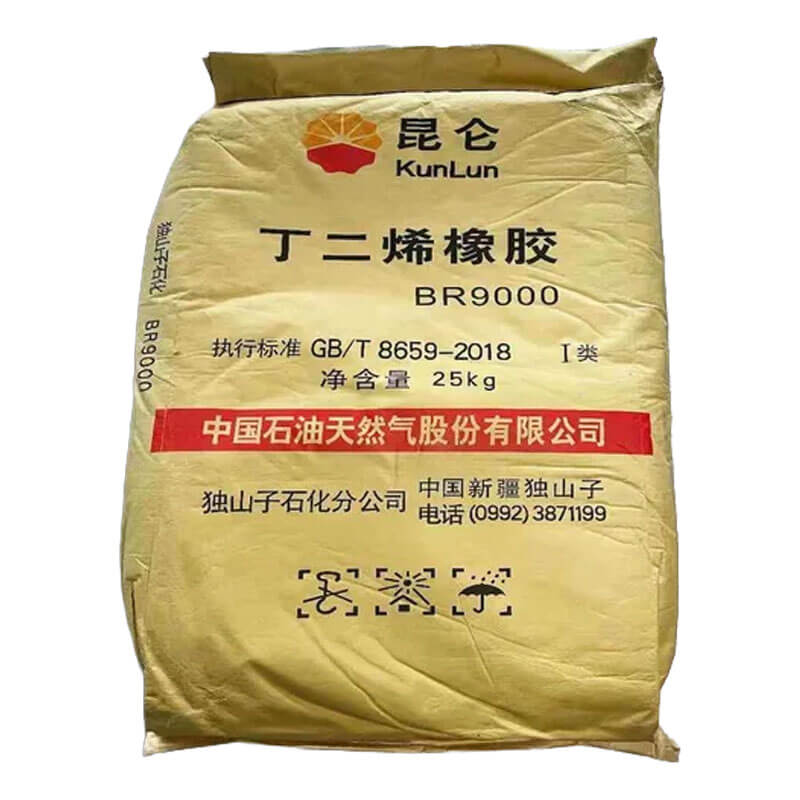
As an accredited High‑cis‑Polybutadiene Rubber BR9000 factory, we enforce strict quality protocols—every batch undergoes rigorous testing to ensure consistent efficacy and safety standards.
| Packing | High-cis-Polybutadiene Rubber BR9000 is packaged as 25 kg bales, wrapped in polyethylene film, palletized, and covered with shrink wrap. |
| Container Loading (20′ FCL) | 20' FCL loading for BR9000: packaged bales on pallets, secured, full container utilization, ensuring safe transport and dry storage conditions. |
| Shipping | High-cis-Polybutadiene Rubber BR9000 ships as bales or blocks, wrapped in polyethylene film, then packed in cartons or crates. Store in cool, dry, ventilated areas, away from heat, sunlight, and oxidizers. Transport by sealed containers or trucks, protecting from moisture and mechanical damage. Avoid open flames during handling. |
| Storage | Store High-cis-Polybutadiene Rubber BR9000 in a cool, dry, well-ventilated area away from direct sunlight, heat sources, ozone-generating equipment, and strong oxidizers. Keep in original, sealed packaging to prevent contamination and moisture pickup. Store flat and supported to avoid deformation, and follow first-in, first-out stock rotation. |
| Shelf Life | High-cis-Polybutadiene Rubber BR9000 has a typical shelf life of two years when stored in a cool, dry, dark, well-ventilated area. |
In two-stage mixing sequences for passenger car radial tread compounds, BR9000 is introduced at 25–35 phr alongside natural rubber and solution-polymerised SBR. This selection is not functionally neutral: high cis-1,4 content, measured on incoming bales by infrared spectroscopy to ISO 12965:2015, places the glass transition temperature near −105 °C. The low Tg reduces hysteresis at service temperature; dynamic mechanical analysis of cured tread specimens is performed on rectangular bars in tensile deformation according to ISO 4664-1, with the loss factor at 60 °C used as a rolling-resistance indicator. The practical limitation is equally clear: uncured tensile strength and dimensional stability are lower than those of natural rubber or SBR, so single-stage mixing is avoided. A typical production line uses a 270 L intermeshing internal mixer with a 0.72 fill factor and rotor speed set at 35–45 rpm. Masterbatch mixing discharges at 145–155 °C to secure carbon black dispersion, while the final sulphur stage is held at 95–105 °C to limit premature crosslinking. The compound is then extruded through a pin-type cold-feed extruder with a 20/40/60 mesh screen pack; barrel zone temperatures are controlled between 55 °C and 75 °C to stabilise die swell. Curing is carried out in a hydraulic multi-cavity press at 160 °C for t90 + 2 min, producing a P215/60R16 tread segment. Compliance for the finished tyre falls under Regulation (EU) 2020/740 on tyre labelling; raw-material documentation for BR9000 is maintained under REACH Article 33 substance communication obligations, with SVHC screening below the 0.1 wt% threshold. Tread abrasion resistance is reported according to DIN ISO 4649, and filler dispersion is evaluated on cured cut sections by ISO 11345:2020. Incoming Mooney viscosity of BR9000 is held within ±2.5 MU to prevent batch-to-batch changes in extruder head pressure, which otherwise transfer directly to tread gauge variation and press flow imbalance.
| Incoming BR9000 release parameter | Test method | Typical control range |
|---|---|---|
| cis-1,4 content | ISO 12965:2015 | ≥96 mol% |
| Mooney viscosity ML(1+4)100 °C | ISO 289-1:2015 | 44–50 MU |
| Volatile matter | ISO 248-1:2021 | ≤0.50 wt% |
| Ash | ISO 247-1:2018 | ≤0.20 wt% |
Incoming quality data from the table is not a substitute for compound-level testing. Processors must still verify cure behaviour on each lot in a moving-die rheometer according to ISO 6502-3:2018, because small variations in cis content and molecular weight can shift optimum cure time by 45–90 s in sulphur-cured tread formulations. The result is that BR9000 cannot be treated as a drop-in replacement for emulsion SBR without adjusting accelerator dosage; laboratory-scale rheometric screening is required before plant-scale adoption.
In high-impact polystyrene lines, BR9000 is dissolved in styrene at 7–12 wt% of the total feedstock. The critical process window is located in the pre-polymerisation section rather than in the devolatilising tower. Rubber–styrene solution viscosity must remain high enough to suspend the nascent polystyrene phase droplets, but low enough to permit stable transfer through the 20–35 m³ continuous stirred-tank reactors. Phase inversion is monitored by agitator torque and in-line near-infrared; the target rubber particle size after inversion is 0.8–2.5 µm. Because BR9000 has a high cis-1,4 content, solution viscosity in styrene at equivalent molecular weight is slightly lower than that of medium-cis grades, which affects the particle size distribution and may require an increase in rubber feed concentration. The process temperature is stepped from 105 °C in the pre-polymeriser to 145–165 °C in the high-viscosity reactor train; devolatilisation at 230–245 °C and 20–40 mbar reduces residual styrene below 500 mg/kg in the pellet. Rubber particle morphology is fixed by the shear rate in the 0.5–2.0 m³ circulation loop; excessive shear reduces particle size below 0.3 µm, causing notched impact failure. The terminal HIPS is evaluated by notched Izod impact according to ISO 180:2019 and melt flow rate according to ISO 1133-1:2022. For food-contact HIPS, converter compliance falls under FDA 21 CFR 177.1640 for rubber-modified polystyrene, and EU food-contact assessment follows Regulation (EU) 10/2011 for plastic materials intended to contact food. Published side-by-side data for BR9000 in this exact continuous mass configuration is limited, so pilot-scale conversion trials are required before a full plant campaign is released.
Truck radial sidewall compounds blend BR9000 with natural rubber at 40–60 phr. The design objective is not rolling resistance but flex-life under repeated sidewall bending and resistance to cut growth from road hazards. A 370 L tangential internal mixer is used for two-stage mixing. The masterbatch stage discharges at 150–160 °C; the final sulphur stage is discharged at 100–110 °C to avoid scorch before extrusion. Antidegradant selection is specific: 6PPD is added at 2.5–3.5 phr and microcrystalline paraffin wax at 1.0–1.5 phr, because the sidewall is continuously exposed to ozone and ultraviolet stress. Carbon black N550 is loaded at 40–50 phr to moderate strain energy and reduce crack propagation. A duplex extruder forms the sidewall profile, which is then applied to a green tyre carcass and cured in a two-cavity hydraulic press. Cut-growth resistance is measured by DeMattia flexing according to ISO 132:2017, with crack length recorded at defined intervals. Ozone resistance is tested under ISO 1431-1:2022 at 50 pphm ozone, 20% strain, 40 °C and 72 h exposure. The terminal product is a 295/80R22.5 sidewall. Regulatory compliance for commercial vehicle tyres is referenced to UNECE R54 and R117 for rolling sound and wet adhesion; BR9000-specific documentation supports the compound dossier but does not replace whole-tyre testing.
For hard-rock conveyor belt covers, BR9000 is used at 15–25 phr in SBR/NR-based cover compounds to improve cut-tear resistance and reduce service abrasion. Mixing is performed in a single-stage internal mixer with drop temperature 120–130 °C; the cover compound is calendered at 4–8 mm thickness and cured in an autoclave at 150–153 °C for 45–60 min. Abrasion is measured under ISO 4649, and belt construction follows DIN 22102-1 for textile anti-abrasive belts. Published data for BR9000 in this exact calender configuration is limited; plant trials typically monitor compound Mooney viscosity to ISO 289-1 and sheet surface after the final calender rolls.
High-resilience solid cores are compression moulded from BR9000-based compounds containing zinc diacrylate at 20–35 phr and dicumyl peroxide at 0.5–1.2 phr. The exotherm is significant because zinc diacrylate free-radical polymerisation adds to peroxide decomposition heat. Mould surface temperature is therefore set 10–15 °C below the desired internal cure temperature; thermocouple studies in 12-cavity hydraulic presses show centre temperatures can exceed platen temperature by 8–20 °C at the upper zinc diacrylate loading. Cure time is 12–18 min at platen temperatures of 150–165 °C, with mould pressure maintained at 14–17 MPa. The core is subsequently covered with an ionomer mantle and finished. High cis-1,4 content in BR9000 contributes to low compressive energy loss; rebound resilience is measured on compression moulded pucks by ISO 4662. Terminal products are subject to initial velocity limits under United States Golf Association protocols, but specific published BR9000 data for this configuration is limited. Handling of zinc diacrylate in the mixing room requires local exhaust ventilation; airborne dust is controlled to the workplace exposure limit applicable in the production jurisdiction.
Wrapped V-belts use BR9000 at 20–35 phr in NR/SBR base compounds to improve crack propagation resistance under cyclic bending around small pulleys. The base compound is mixed in a 50 L intermeshing mixer, then calendered onto frictioned fabric at 0.8–1.2 mm gauge. Curing is performed in a rotary vulcaniser or multi-daylight press at 150–160 °C. Dynamic crack initiation resistance is monitored on accelerated belt test rigs under ISO 4649 for cover wear and ISO 4662 for rebound; the finished belt is checked for cross-section dimensions and cord displacement. Published data for BR9000 in this exact belt-building line is limited, so incoming polymer lots are screened by Mooney viscosity and rheometer cure profile before use in production mixes.
Competitive High‑cis‑Polybutadiene Rubber BR9000 prices that fit your budget—flexible terms and customized quotes for every order.
For samples, pricing, or more information, please contact us at +8618136850665 or mail to sales4@ascent-chem.com.
We will respond to you as soon as possible.
Tel: +8618136850665
Email: sales4@ascent-chem.com
Flexible payment, competitive price, premium service - Inquire now!
Commercial grade BR9000 is a nickel-catalyzed solution-polymerized high-cis polybutadiene rubber. The grade designation appears in Chinese national standard GB/T 8659-2018 and in evaluation protocols derived from ISO 2476:2020 for butadiene rubber. The polymer is characterized by a cis-1,4 content of ≥96.0 % and a Mooney viscosity ML 1+4 at 100 °C typically in the 40–50 range. The vinyl-1,2 content is typically below 1.0 %, and the final bale contains a stabilizer package added during finishing. BR9000 is supplied as wrapped or compacted bales and is intended for tire tread and sidewall compounds, conveyor belt covers, rubber hoses, and impact modification of polystyrene. Compared with low-cis lithium-catalyzed BR, the higher cis-1,4 regularity reduces hysteresis and improves abrasion resistance under DIN 53516 and ASTM D5963 test conditions, but it also lowers wet skid resistance when used as the sole tread polymer. The material is a general-purpose unsaturated elastomer subject to REACH registration obligations when imported into the European Economic Area.
The performance of BR9000 is governed by the geometric regularity of the butadiene repeat unit. In high-cis BR, the 1,4-cis configuration produces a chain with a low glass transition temperature near −105 °C and a high degree of rotational freedom. This translates to low hysteresis at service temperatures. Under dynamic deformation, energy loss per cycle is lower than in SBR or low-cis BR, a difference commonly captured by tan δ measurements performed in accordance with ISO 6721-1:2019. High cis content also permits strain-induced crystallization at high elongation, which raises tensile strength and tear resistance in gum and lightly reinforced vulcanizates; however, the effect is weaker than that observed in natural rubber. Sulfur vulcanization kinetics are controlled by the allylic hydrogen sites adjacent to the double bonds. The cure rate of nickel-catalyzed high-cis BR is intermediate between that of neodymium-catalyzed BR and lithium-catalyzed BR when evaluated by ASTM D5289 moving die rheometer at 160 °C. Reversion resistance is generally better than natural rubber but inferior to EV-cure EPDM. BR9000 is not suitable for applications requiring inherent oil resistance; aromatic and aliphatic hydrocarbon service requires NBR or HNBR. The unsaturated backbone is vulnerable to ozone cracking, and antiozonant loading is mandatory for dynamic outdoor service.
The following values are representative specification limits, not batch-specific certificates of analysis. Actual certificates of analysis may list narrower internal control limits.
| Parameter | Test method | Representative limit or range | Unit |
|---|---|---|---|
| Mooney viscosity ML 1+4 at 100 °C | ASTM D1646-19a / ISO 289-1:2018 | 40–50 | MU |
| cis-1,4 content | FTIR internal method aligned with ISO 12965 | ≥96.0 | % |
| Volatile matter | ASTM D5668-21 / ISO 248:2018 | ≤0.5 | % |
| Ash content | ISO 247:2020 | ≤0.3 | % |
| Gel content | Filtration or gravimetric internal method | ≤0.5 | % |
| Density | ISO 2781:2018 | 0.90–0.92 | g/cm³ |
| Glass transition temperature | ISO 11357-2:2020 | −105 to −100 | °C |
The grade BR9000 should not be confused with BR9002 or BR9004 designations, which may differ in Mooney viscosity, gel specification, or oil extension. Substitution without reformulation is not advisable because batch-to-batch Mooney variation, catalyst residues, and stabilizer type can shift processing behavior.
In compounding operations, BR9000 is rarely used as a sole elastomer because its high resilience and low glass transition temperature are accompanied by low green strength and high cold flow. Laboratory-scale mixing studies commonly use a tangential internal mixer with a 1.5 L chamber volume and a fill factor of 0.75. Production lines may use 270 L or 320 L intermeshing or tangential mixers. Specific energy input for carbon black incorporation in high-cis BR compounds is generally lower than for SBR at equal filler volume fraction. Typical dump temperatures fall in the 130–150 °C range at rotor speeds of 50–60 min⁻¹; above 160 °C, gel formation and scorch risk increase. On a two-roll mill, BR9000 bands cleanly at roll temperatures of 40–60 °C, but cold flow can cause bagging if the stock is left too long without rotation. Bale storage below 30 °C reduces cold flow. High stacking heights and warehouse temperatures above 30 °C cause bale deformation and sticking. If bales have cold-flowed, mill banding and feeding consistency deteriorate. The stabilizer added during finishing is adequate for storage but is not sufficient for long-term ozone exposure; additional antiozonant and antioxidant are required in the final compound. Surface condensation on chilled bales in humid warehouses can introduce water into the compound. Pre-drying at 40–50 °C for 2 h is used only when moisture-derived porosity is observed.
Tire tread formulations use BR9000 at 30–50 phr in passenger car treads and 20–35 phr in truck and bus treads. The lower bound is set by processing safety and tear strength; the upper bound is set by wet traction and abrasion balance. In a 50 phr SBR/50 phr BR blend, DIN 53516 abrasion loss is reduced relative to the SBR-only control, while tan δ at 0 °C decreases, indicating a loss in wet grip. The use of high-surface-area silica in combination with silane coupling agents can partially offset the wet skid reduction, but it increases mixing viscosity. For sidewall compounds, BR9000 improves flex crack resistance under ASTM D813; typical BR levels are 20–40 phr with natural rubber or SBR. In truck tire treads, natural rubber is retained at 60–80 phr to limit heat build-up; BR9000 at 20–30 phr improves wear at the expense of tear strength. On a 320 L intermeshing mixer, silica-filled tread compounds containing BR9000 require silane reaction temperatures of 145–155 °C; exceeding 165 °C causes premature coupling and scorch. BR9000 is not recommended as a sole polymer in winter tire treads, where high wet grip and low-temperature flexibility require high-vinyl or functionalized S-SBR grades.
Because catalyst residue level and molecular weight distribution differ among solution BR grades, direct substitution of BR9000 for Nd-BR or Li-BR without reformulation is not advisable. Comparative data from polymer characterization laboratories show structural differences that dictate reformulation.
| Parameter | BR9000 Ni-BR | Nd-BR | Li-BR |
|---|---|---|---|
| cis-1,4 content | ≥96 % | ≥98 % | 35–40 % |
| Vinyl-1,2 content | <1 % | <1 % | 10–20 % |
| Mooney ML 1+4 at 100 °C | 40–50 | 40–50 | 35–55 |
| Catalyst residue character | Nickel compounds | Neodymium compounds | Lithium compounds |
| Green strength | Low | Low | Low to moderate |
| Molecular weight distribution | Broad | Medium broad | Narrow to medium |
Published data for direct substitution in proprietary tire formulations is limited. The broader molecular weight distribution of nickel-catalyzed BR supports mill banding and extrusion, but it may reduce tear strength relative to neodymium-catalyzed BR. Lithium-catalyzed low-cis BR offers better wet traction due to its higher vinyl content, but it sacrifices abrasion resistance and resilience. Reformulation should therefore include rebalancing of sulfur, accelerator, carbon black, and process oil levels rather than simple replacement of the polymer.